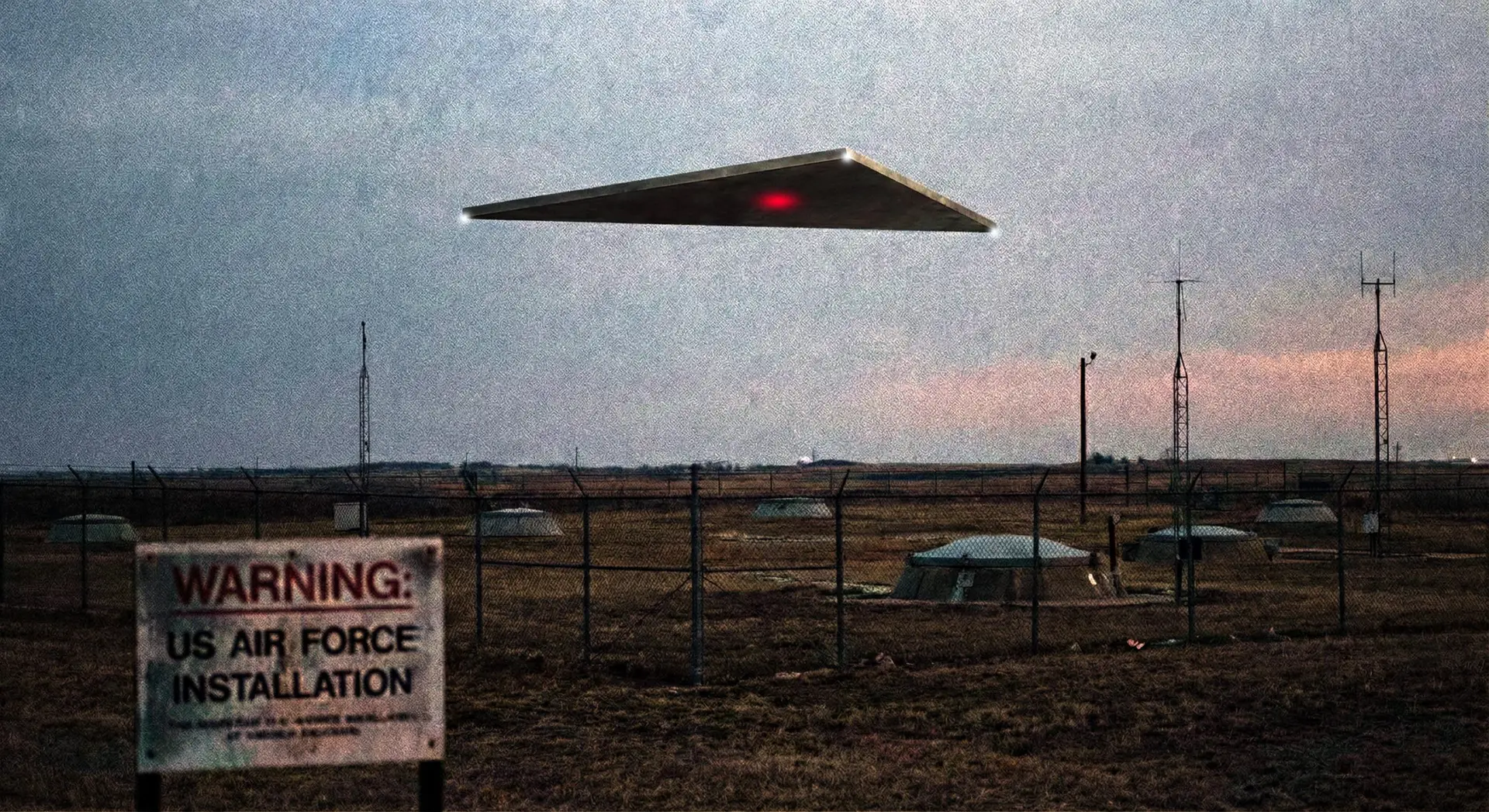
“The Air Force had put out a secret order for its pilots to capture UFOs. For the last six months we have been working with a congressional committee for investigating official secrecy concerning proof that UFOs are real machines under intelligent control.”
- Major Donald Keyhoe, USAF (1957)
Congress forced a quiet reckoning inside the national-security structure when it created the All-domain Anomaly Resolution Office (AARO). The mandate arose through the 2023 and 2024 National Defense Authorization Acts (NDAA), dense statutory juggernauts that required a central clearinghouse for unidentified anomalous phenomena (UAP) records, whistleblower disclosures, and historical investigations.¹
However, the legislation did more than create a new office. It has created an entirely new gatekeeping system. AARO now sits at the four-way intersection of secrecy law, classification policy, contractor control, and public sentiment. Its 2025 declassification workflow, the internal playbook that guides case triage and release decisions, reveals how the government continues to conceal UAP data under the guise of transparency.
Section 1673 of the FY2023 NDAA ordered the creation of a centralized UAP body with authority to receive reports from any government employee or contractor with knowledge of UAP programs.² Congress then expanded the mandate in the FY2024 NDAA, directing AARO to produce a comprehensive “Historical Record Report” and to develop a process for declassifying UAP materials “to the greatest extent feasible.”³
The phrase carries considerable weight. Congress used it to force a sliver of sunlight through the classification wall. But the statute did not alter the wall itself. Agencies still control their own equities. Contractors still control proprietary claims under federal procurement law, and Special Access Programs (SAPs) still override normal disclosure rules under Executive Order 13526.⁴ AARO’s playbook operates inside these strictures.
AARO’s workflow begins with a set of manuals drawn from the DoD Manual 5200.01 series—cornerstone documents that govern classification, derivative classification, and declassification review.⁵
Every UAP case file, sensor logs, imagery, cockpit audio, and tracking data first enters a classification check against these rules. Three triggers halt release:
- Operational Security (OPSEC): Details that reveal patrol patterns, surveillance windows, or platform capabilities.
- Intelligence Sources and Methods (ISM): Material under direct oversight of ODNI, CIA, NSA, NRO, or DIA.
- Sensitive Technology: Signatures associated with stealth platforms, sensor suites, missile tests, or experimental craft.
AARO cannot override these restrictions. The rules bind the reviewers even when a UAP event contains no classified content by itself. The presence of a classified platform inside the data forces the entire record into higher and more restrictive compartments. It is this bottleneck that shapes the scope of what the public sees.
Congress inserted new whistleblower safeguards in §1673(b)(1) of the FY2023 NDAA.⁶ This statute gives employees and contractors a protected path to report hidden UAP programs, including material “shielded by any form of classification or restricted access.”
The playbook describes a two-stage process:
- Logging and Cross-Referencing: AARO enters each disclosure into a closed database, then checks for matches with older claims, contractor programs, and reports housed in classified archives.
- Equity Routing: If a disclosure touches an SAP, a waived SAP, or a compartment owned by an intelligence agency, AARO must transfer the material into that agency’s review pipeline.
Statutory protection remains intact, but the substance moves behind a barrier the public cannot breach. The law created a channel, but the classification system limits its reach. In other words, all the relevant and most compelling data remains classified. Like Bluebook, AARO’s function appears to be an effort to placate public interest in the subject yet provide no useful data to the public.
One thing Congress did was to order AARO to publish a multi-volume history of U.S. government involvement with UAP.⁷ Volume I, released in 2024, unsurprisingly framed historical UAP incidents as misidentified aircraft, atmospheric phenomena, or classified U.S. programs.⁸ The report drew from available documents inside DoD and IC holdings, but AARO could only use material cleared through classification review. Again, only bleached and laundered data provided the basis for the report. The review glaringly excludes SAP-linked contractor studies; intelligence test events with embedded UAP correlations; sensor logs tied to nuclear security missions; and records under active litigation holds or proprietary claims.
The public received a curated narrative shaped by legal constraints rather than full evidentiary access. The absence of evidence inside Volume I cannot be read as proof that no evidence exists. It reflects the structure of secrecy that severely hinders AARO’s, and thereby the public’s, reach.
AARO performs quarterly declassification reviews under DoD Manual 5200.01, Volume 3. These rules govern systematic review, exemptions, and referrals.⁹ The playbook prescribes a sequence before public disclosure.
- Analyst Selection: Analysts propose a batch of UAP materials for review.
- Equity Checks: Each item circulates to the origin agency. NSA, NRO, DIA, CIA, or STRATCOM can veto release.
- Contractor Notice: If Lockheed Martin, Raytheon, Northrop Grumman, or another defense contractor appears as a custodian or platform owner, AARO must perform a “submitter notice” under FOIA Exemption 4.¹⁰
- Legal Review: Attorneys screen for export-control restrictions under ITAR and EAR.¹¹
- Final Clearance: Only items that clear all hurdles move to public release.
Obviously, one contractor objection or one intelligence-equity claim can freeze an item permanently. Simply put, Congress cannot force release without new legislation. AARO cannot overrule equity owners. The classification structure prevails every time. Like Bluebook, AARO has no authority to investigate cases that may affect national security. In fact, AARO is under even stricter guidelines.
Executive Order 13526 grants intelligence agencies absolute control over their own classified information.¹² AARO’s playbook notes this reality in plain terms: ODNI, CIA, NSA, DIA, and NRO retain final authority over any record containing their equities. AARO cannot compel their release. It cannot reclassify their material. It cannot challenge Intelligence community determinations. The UAP issue enters this same structure. The national-security apparatus treats anomaly data the same way it treats satellite telemetry, SIGINT (Signals Intelligence) intercepts, and platform signatures. The topic gains attention, but the law remains unchanged.
AARO’s briefings promise transparency, but the legal framework produces a narrower outcome. Transparency, inside this system, means releasing the agencies’ previously cleared material that carries no operational risk, no technical sensitivity, and no contractor claims. The public sees only safe fragments. The sensitive core remains sealed.
Like Bluebook, AARO functions as a lawful intermediary, not a reformer. Its playbook reveals a stark, bureaucratic truth: the office manages visibility; it neither redefines nor provides it. The gatekeepers of the Legacy Program continue to guard the true archive. Like remoras feeding on shark leftovers, the public only sees whatever manages to squeeze its way through the legal mesh, morsel by tiny morsel. All of the real data gets swallowed whole and remains in the belly of the beast.
FOOTNOTES:
- James M. Inhofe National Defense Authorization Act for FY2023, Pub. L. No. 117-263, §§1673–1683 (2022).
- Id. §1673(a)–(c) (establishing the UAP office and its authorities).
- National Defense Authorization Act for FY2024, Pub. L. No. 118-31, §§1841–1843 (2023).
- Exec. Order No. 13526, 75 Fed. Reg. 707 (Dec. 29, 2009) (governing classification, declassification, and SAP controls).
- DoD Manual 5200.01, Vols. 1–4 (2013–2017) (classification, marking, declassification, and safeguarding rules).
- FY2023 NDAA §1673(b)(1) (protected disclosures and whistleblower authority).
- FY2024 NDAA §1842 (Historical Record Report mandate).
- AARO Historical Record Report, Volume I (Office of the Secretary of Defense, 2024).
- DoDM 5200.01, Vol. 3 (Systematic Declassification Review).
- 5 U.S.C. §552(b)(4) (FOIA Exemption 4); Executive Order 12600 (submitter notice).
- 22 C.F.R. Parts 120–130 (ITAR); 15 C.F.R. Parts 730–774 (EAR).
- E.O. 13526, §3.1(d) (agency control over classification decisions).
Be First to Comment